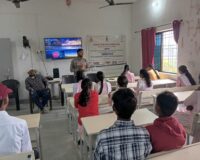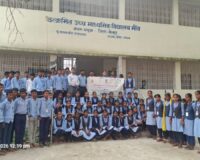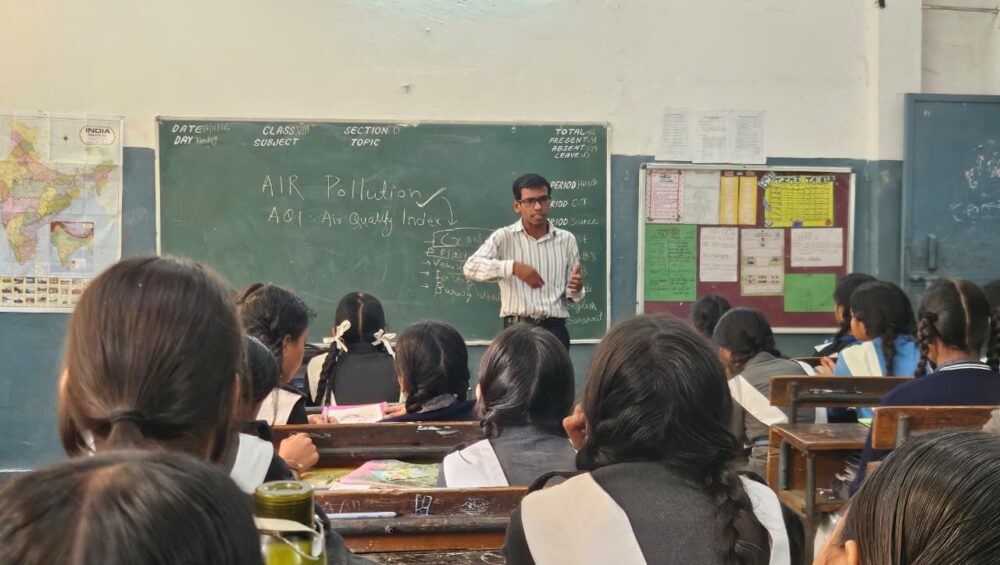
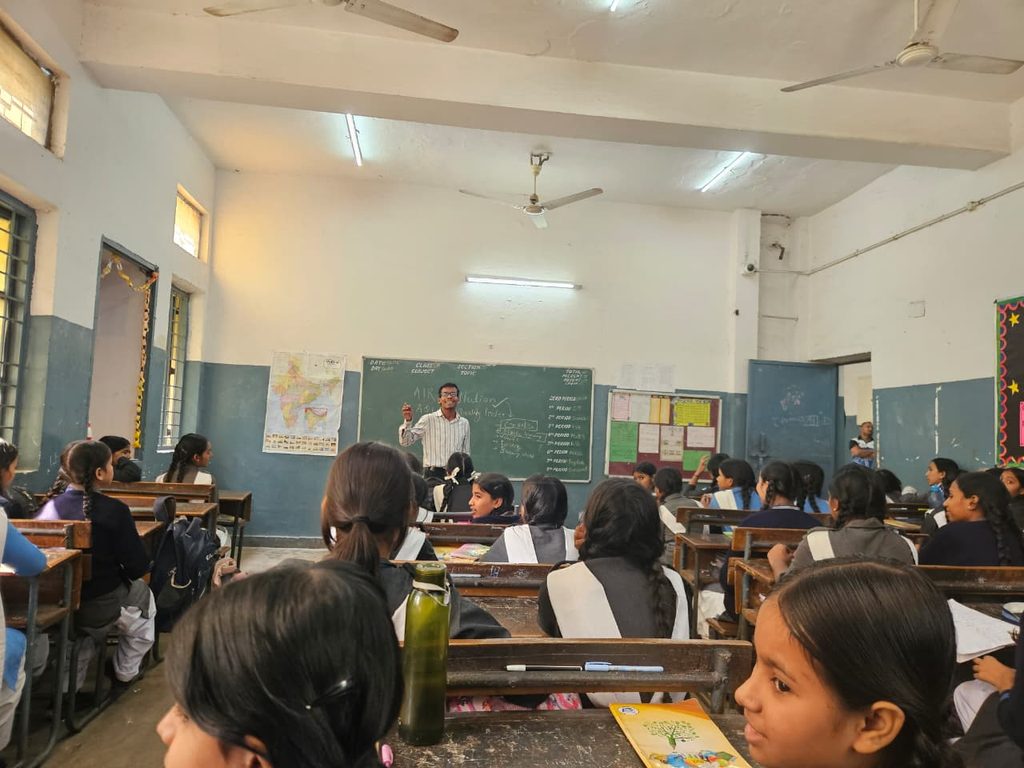
Green Pencil Foundation conducts an interactive Nature Education Programme at Sarvodaya Kanya Vidyalaya, engaging students across all five Grade 8 sections in understanding air pollution, its impact on human health and the importance of clean air.
What if the air we breathe every day is silently affecting our ability to learn, play, grow and live healthy lives? More importantly, what if the next generation does not know how to measure or understand the quality of the air around them?
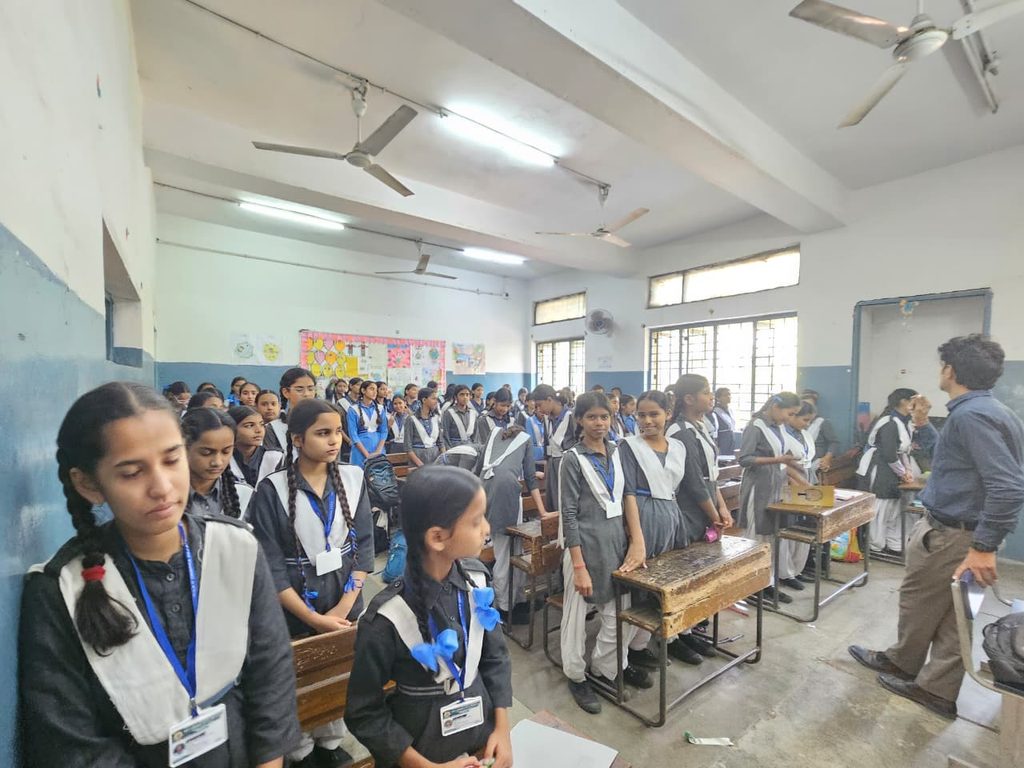
Taking this conversation into the classroom, Green Pencil Foundation conducted a Nature Education Programme on Air Pollution at Sarvodaya Kanya Vidyalaya for Grade 8 students across all five sections.
The programme went beyond conventional classroom teaching, introducing students to the science of air pollution, real-world AQI monitoring, international air quality comparisons, public health and the constitutional significance of clean air.
The objective was simple: help children understand that air pollution is not just a chapter in an environmental science textbook. It is a reality that affects their families, communities and everyday lives.
Understanding the Air We Breathe: Learning to Read AQI
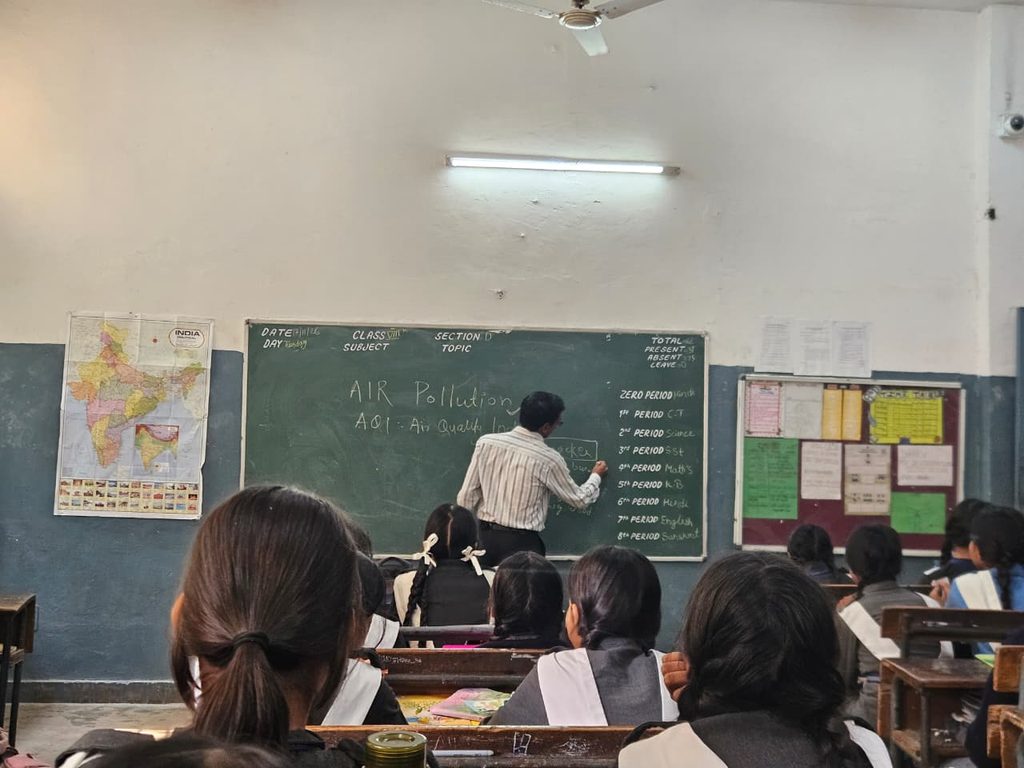
One of the central components of the programme was understanding the Air Quality Index (AQI) and how it helps people interpret the quality of the air around them.
Students were introduced to the concept of AQI monitoring and learned how different pollutants contribute to air pollution. The discussion focused particularly on PM2.5 and PM10 tiny particulate matter that can enter the respiratory system and pose serious health risks.
Students explored India’s National Air Quality Index, developed to communicate air quality through a simple numerical scale and six categories:
| AQI Range | Air Quality Category |
|---|---|
| 0–50 | Good |
| 51–100 | Satisfactory |
| 101–200 | Moderate |
| 201–300 | Poor |
| 301–400 | Very Poor |
| 401–500 | Severe |
Through this exercise, students learned that AQI is more than just a number displayed on mobile applications or television screens. It is an important public information tool that can help people make informed decisions about outdoor activities, exercise and exposure to polluted air.
India vs Canada: Understanding Air Quality Beyond Borders
Can two countries measure air quality differently? Can we compare their pollution levels using the same scale?
These questions made the international comparison activity particularly interesting.
Students explored air quality information from India and Canada, learning how different countries monitor and communicate air pollution.
An important learning point was that India primarily uses its National AQI system, while Canada uses the Air Quality Health Index (AQHI), a health-risk communication system.
The Canadian AQHI uses a scale from 1 to 10+, whereas India’s National AQI uses a scale from 0 to 500.
Students were encouraged to understand why comparing the raw numbers from these two systems would be misleading and why pollutant concentrations, monitoring methods and health implications matter when evaluating air quality.
The exercise helped connect environmental issues in India with the wider global conversation on clean air and public health.
Air Pollution and Human Health: Who Is Most at Risk?
Air pollution does not affect everyone equally. Children, older adults and people with existing respiratory or cardiovascular conditions can be particularly vulnerable.
The programme introduced students to the health consequences of exposure to polluted air, including:
- Respiratory difficulties and breathing discomfort.
- Increased risk and aggravation of asthma.
- Reduced lung function and impaired respiratory health.
- Cardiovascular complications associated with long-term exposure.
- Potential effects on children’s growth, development and overall well-being.
According to the World Health Organization (WHO), approximately 93% of children under the age of 15 worldwide were exposed to air containing pollutants at levels that placed their health and development at risk, based on WHO’s 2018 report using 2016 exposure estimates.
This statistic helped students understand that air pollution is not a distant environmental challenge. It is a public health issue that directly concerns their generation.
The discussion also highlighted the importance of protecting elderly family members, young children and individuals who are more sensitive to poor air quality.
What Does WHO Say About Safe Air? Understanding Permissible Limits
Another important learning component focused on the World Health Organization’s Global Air Quality Guidelines, updated in 2021.
Students were introduced to the recommended levels of particulate matter and why even relatively low concentrations of air pollution can affect human health.
Some of the key WHO recommendations discussed were:
| Pollutant | Annual Guideline | 24-Hour Guideline |
|---|---|---|
| PM2.5 | 5 µg/m³ | 15 µg/m³ |
| PM10 | 15 µg/m³ | 45 µg/m³ |
These figures represent WHO health-based guideline levels, not India’s legally enforceable ambient air quality standards.
The distinction was important: students learned that an AQI category and a pollutant concentration are not the same thing. Understanding the actual concentration of pollutants helps explain the health risks behind the numbers.
The discussion encouraged students to question what clean air should look like and why governments and communities need stronger air pollution prevention measures.
Before and After Diwali: Understanding the Impact of Firecrackers
Diwali celebrations also became an important part of the classroom discussion.
Students explored how firecrackers release particulate matter and other pollutants into the atmosphere, potentially contributing to short-term deterioration in air quality.
The programme introduced a pre- and post-Diwali air quality comparison exercise, helping students understand how AQI readings can change around festival periods.
They discussed the relationship between firecracker emissions, weather conditions, atmospheric mixing and the accumulation of pollutants.
The activity also helped students recognise that air pollution is influenced by several sources, including vehicular emissions, construction dust, industrial activities, waste burning and seasonal factors.
Rather than treating firecrackers as the only cause of poor air quality, students were encouraged to understand the wider pollution picture and the importance of responsible celebrations.
Clean Air Is a Fundamental Right: Connecting Environment with the Constitution
Perhaps one of the most meaningful discussions of the programme focused on a question that connects environmental protection with citizenship:
Is clean air a privilege or a fundamental right?
Students were introduced to Article 21 of the Constitution of India, which guarantees the fundamental right to life and personal liberty.
Through judicial interpretation, the Supreme Court of India has recognised that the right to life includes the right to live in a pollution-free and healthy environment.
The discussion also introduced Article 51A(g), which establishes the fundamental duty of every citizen to protect and improve the natural environment, including forests, lakes, rivers and wildlife.
This helped students understand that environmental protection is not solely the responsibility of governments or environmental organisations. Every citizen has a role to play.
The programme encouraged students to see clean air not merely as an environmental expectation but as an issue of public health, constitutional values and collective responsibility.
Building Environmental Awareness Through Experiential Education
The Nature Education Programme was designed to make environmental learning relevant to students’ everyday experiences.
Instead of limiting the discussion to definitions and theoretical concepts, the sessions connected scientific information with familiar situations checking AQI before going outside, understanding why breathing becomes difficult during high-pollution days, discussing the effects of firecrackers and comparing air quality information across countries.
Conducting the programme across all five Grade 8 sections also provided an opportunity to take the conversation to a wider group of students within the school.
For Green Pencil Foundation, the initiative reflects an important belief: environmental education should help children understand the challenges around them and develop the knowledge to become responsible citizens.
Green Pencil Foundation’s Commitment to Clean Air Education
Air pollution is one of the most pressing environmental and public health challenges of our time. Addressing it requires scientific awareness, informed communities, responsible behaviour and stronger collective action.
Green Pencil Foundation believes that schools are among the most important spaces for building this awareness.
Through its Nature Education Programmes, the Foundation aims to make environmental learning more practical, engaging and connected to real-world challenges.
The session at Sarvodaya Kanya Vidyalaya was another step towards helping young learners understand the relationship between the environment and human health.
Because the future of clean air cannot depend only on policies and discussions. It also depends on how well the next generation understands the problem and participates in finding solutions.
A child who learns to read the AQI today may become the citizen who demands cleaner air tomorrow.
And that is where meaningful environmental education begins.